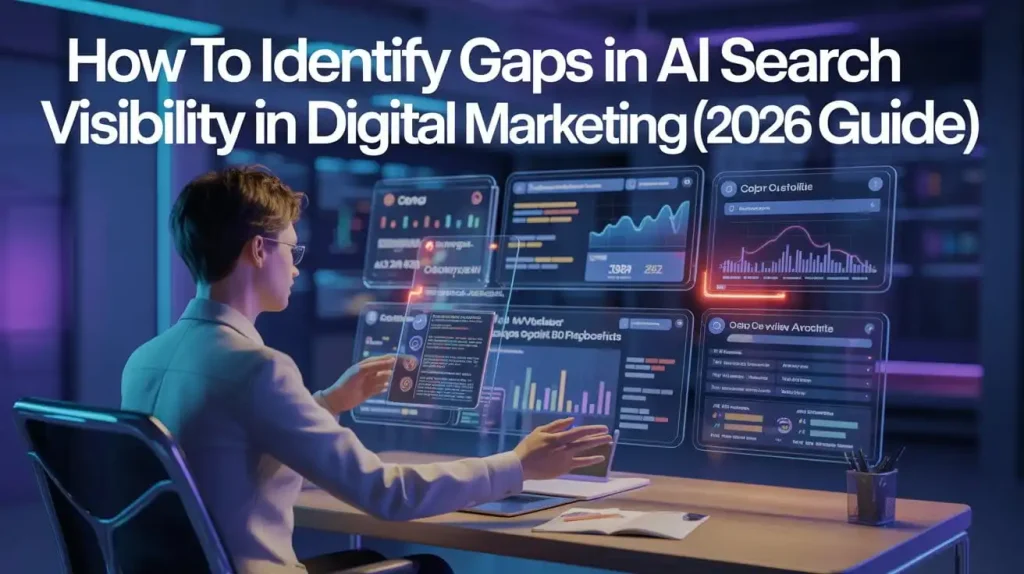
Search is no longer just about ranking on Google.
In 2026, visibility depends on whether your content appears inside:
- Google AI Overviews
- Conversational AI answers
- LLM-powered search systems
- AI-driven recommendations
This shift has created a new problem in digital marketing:
Many websites still rank, but they are invisible in AI-generated answers.
This missing exposure is called an AI search visibility gap.
Most brands still optimize for keywords and backlinks, while AI systems evaluate:
- Contextual authority
- Entity understanding
- Content usefulness
- Information depth
- Trust signals
This guide explains how to identify those hidden gaps and fix them using a structured, modern SEO approach.
What Is AI Visibility and Why Does It Matter?
AI visibility refers to how often your brand or content appears in AI-generated search experiences, such as:
- AI Overviews
- Chat-based search engines
- Generative answer systems
- AI recommendation layers
Unlike traditional SEO, AI systems don’t just rank pages—they synthesize answers.
That means your visibility depends on:
- How well your content is understood
- How strongly your brand is recognized as an entity
- How useful and complete your answers are
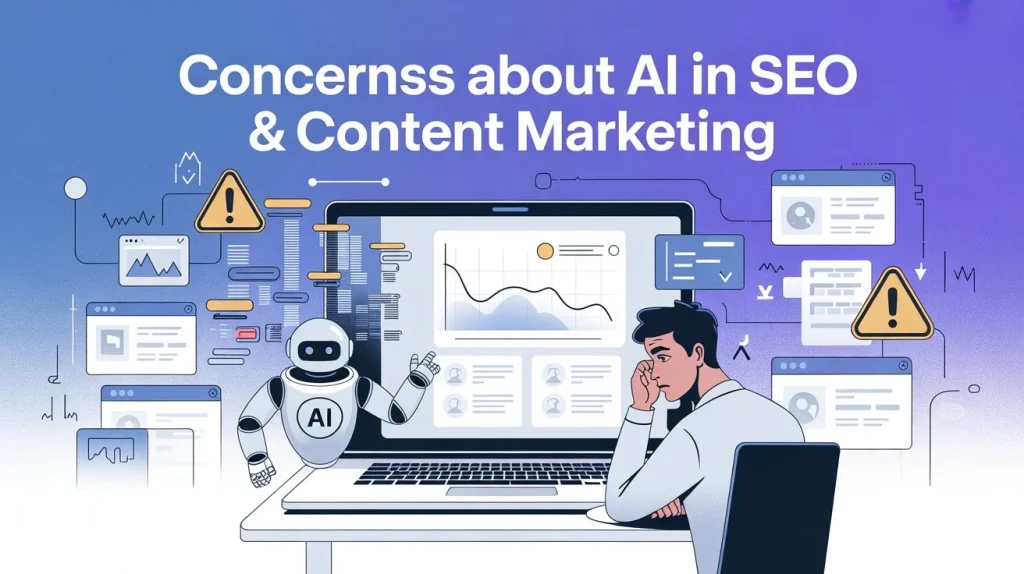
This is why topics like Concerns About AI in SEO and Content Marketing are becoming critical—because AI is changing not just how content is created, but how it is evaluated and surfaced.
Table of Contents
Why AI Is Changing Search
AI has fundamentally changed how search engines work.
Natural Language Understanding (NLP)
Search engines now understand meaning, not just keywords.
Generative Search Experiences (GSE)
Instead of showing links, AI generates full answers.
Zero-Click Behavior
Users often get answers without visiting websites.
Conversational Search
Search is becoming dialogue-based instead of query-based.
Content Must Now Serve Both Humans and AI
Modern content must be:
- Structured
- Context-rich
- Easy to summarize
- Entity-driven
- Trust-focused
Entities Matter More Than Keywords
AI systems rely heavily on entities such as:
- Brands
- Topics
- People
- Tools
- Concepts
This is where SEO is shifting from keyword targeting → meaning targeting.
What Is a Brand Gap Analysis?
A brand gap analysis identifies the difference between:
- Where your brand currently appears
vs - Where it should appear in search and AI systems
It evaluates:
- Visibility
- Authority
- Content coverage
- Entity presence
- Competitive positioning
In AI-driven search, this is critical because AI systems prefer brands that demonstrate consistent authority across topics.
Understanding the AI Visibility Gap
An AI visibility gap exists when:
- Competitors appear in AI answers
- Your brand does not
- Even if you rank on Google
This happens because AI systems prioritize:
- Content depth
- Semantic clarity
- Source authority
- Contextual completeness
This is closely related to concepts explained in How to Show Up in AI Overviews SEO, where visibility depends on being “understandable” to AI systems—not just ranking signals.
Core Dimensions of a Brand Gap Analysis
A strong analysis includes:
- Entity clarity
- Keyword coverage
- AI visibility presence
- Brand mention tracking
- Competitor benchmarking
- Content depth evaluation
- EEAT strength
This gives a full picture of your digital authority.
1. Define Your Branded Entities and Connect Them to Key Topics
AI systems interpret your brand through entities.
To improve visibility, your brand must clearly connect with:
- Core services
- Industry topics
- Relevant problems
- Expertise areas
If your brand is not strongly linked to meaningful topics, AI systems struggle to categorize your authority.
2. Benchmark Your Current Brand Visibility Online and in Search
Before fixing gaps, measure:
- Where you appear in search
- Where competitors appear in AI results
- How often your brand is mentioned
- Which topics do you dominate
Without benchmarking, visibility issues remain invisible.
3. Find Keywords Your Brand Should Rank For (But Doesn’t)
Identify:
- High-intent queries
- Industry questions
- Comparison-based searches
- Problem-solving topics
These represent missed opportunities where competitors are currently capturing attention.
4. Find Your Brand Gaps in AI Search
Search your key topics in:
- Google AI Overviews
- ChatGPT
- Perplexity AI
Then check:
- Are competitors cited instead of you?
- Which sources are used?
- What content formats are preferred?
This reveals direct AI visibility loss.
5. Find Gaps in Your Branded Mentions Around the Web
AI systems trust brands that are widely referenced.
Check:
- Industry mentions
- Blog citations
- Forum discussions
- PR coverage
If your brand is not widely referenced, AI systems treat it as less authoritative.
6. Find Where Your Brand Visibility Falls Behind Competitors
Compare competitors based on:
- Content depth
- AI Overview presence
- Topic coverage
- Entity strength
- External mentions
This shows exactly where authority gaps exist.
7. Turn Insights Into a Strategy and Share With Stakeholders
Once gaps are identified, convert them into:
- Content plans
- SEO roadmaps
- Topic clusters
- Authority-building strategies
This ensures SEO becomes a business strategy—not just content production.
Step-by-Step: How to Find AI Visibility Gaps Using Free Tools
Step 1: Run a Manual AI Search Audit
Search your target keywords and analyze:
- Which brands appear in AI answers
- What structure is used
- What type of content gets cited
Step 2: Use Google Search Console for Content Gaps
Look for:
- High impressions but low clicks
- Declining CTR pages
- Weak-performing queries
These often signal AI-driven visibility loss.
Step 3: Use Google “People Also Ask” and Autocomplete
These reveal:
- Missing subtopics
- Intent gaps
- Content expansion opportunities
Step 4: Use Perplexity AI for Competitive Insights
Check:
- Which sources are trusted
- Which competitors dominate answers
Step 5: Check Structured Data and Schema Markup
Schema helps AI systems understand:
- Content structure
- Entity relationships
- Page meaning
Step 6: Use ChatGPT as a Search Diagnostic Tool
Ask your niche questions and observe:
- Which brands appear
- Which topics dominate responses
Why Manual AI Gap Analysis Doesn’t Scale
Manual tracking fails because:
- AI results change constantly
- SERPs vary by user
- The data is too large
- Trends shift quickly
That’s why automation is becoming essential.
This is also where modern tools like How AI SEO Tools Help Scale Agile SEO become useful for scaling analysis efficiently.
Building an AI-Powered Gap Analysis System
Modern SEO teams are shifting toward automated visibility tracking systems.
These systems monitor:
- AI Overview presence
- Brand mentions
- Competitor citations
- Topic visibility
How It Works
A typical system includes:
- SERP tracking
- AI query analysis
- Entity mapping
- Competitor monitoring
The 20-Minute Build: ChatGPT + Chrome + API
A lightweight version can be built using:
- ChatGPT for code generation
- Chrome extensions for monitoring
- API integration for analysis
Step 1: Generate tool logic with ChatGPT
Step 2: Install extension
Step 3: Connect API
Step 4: Test on real queries
What the Gap Analysis Actually Reveals
A proper audit uncovers:
- Missing topical authority
- Weak EEAT signals
- Content structure problems
- Competitor dominance patterns
- AI citation behavior
Failure Modes and Limitations
AI visibility tracking still has limitations:
- No stable ranking system
- AI results vary constantly
- Limited transparency in AI models
Key Takeaways: Modern Content Gap Analysis
Modern SEO gap analysis is no longer about keywords.
It is about:
- Meaning
- Context
- Authority
- Information depth
Tip #1: Why Old Gap Analysis Fails
Search is shifting from:
- pages → answers
- keywords → meaning
- ranking → visibility
Tip #2: Modern Content Gap Types
- Semantic gap (what you cover)
- Intent gap (why users search)
- Format gap (how content is structured)
- Value gap (what extra insight you provide)
Tip #3: Information Gain Matters
AI systems prefer content that adds:
- New insights
- Original perspectives
- Real examples
Tip #4: Strategic Workflow
- Competitor analysis
- Intent mapping
- Content prioritization
Tip #5: EEAT Matters More Than Ever
Strong visibility requires:
- Experience
- Expertise
- Authority
- Trust
Tip #6: Technical SEO Still Matters
Structure improves AI readability.
Tip #7: Real Case Insights
Brands that improve structure + authority see:
- Higher AI mentions
- Better visibility
- Stronger conversions
Tip #8: Trust + Freshness Gap
Outdated content loses AI visibility quickly.
How to Improve Your AI Search Visibility
To close visibility gaps:
- Improve semantic SEO
- Strengthen topical authority
- Add structured data
- Improve EEAT signals
- Create deeper content
Measuring Success in AI Search (2026)
Success is now measured by:
- Share of AI visibility
- Brand mentions in AI answers
- Topic authority strength
Final Thoughts
AI search has completely changed how visibility works.
It is no longer enough to rank.
You must be:
- Understandable to AI systems
- Trusted by algorithms
- Relevant across topics
- Strong in entity networks
Brands that adapt early will dominate the next era of search.
FAQs
1. What is AI search visibility gap analysis in digital marketing?
AI search visibility gap analysis is the process of finding where your brand is missing in AI-generated search results like Google AI Overviews, ChatGPT answers, and other generative search systems. It helps identify why competitors appear in AI answers while your content does not.
2. Why is my website not showing in AI Overviews?
Your website may not appear in AI Overviews due to weak topical authority, poor EEAT signals, lack of structured data, thin content, or missing entity optimization. AI systems prefer content that is clear, authoritative, and deeply relevant to user intent.
3. How do I find AI visibility gaps for my brand?
You can find AI visibility gaps by analyzing AI Overviews for your target keywords, checking competitor mentions, reviewing Google Search Console data, exploring People Also Ask sections, and testing queries in AI tools like ChatGPT or Perplexity AI.
4. What tools can help identify AI search visibility gaps?
Free tools include Google Search Console, Google search (AI Overviews), People Also Ask, autocomplete suggestions, Perplexity AI, and ChatGPT search mode. These help you compare your visibility with competitors.
5. What is the difference between SEO gaps and AI visibility gaps?
SEO gaps focus on missing keywords and rankings, while AI visibility gaps focus on whether your content is being used or cited in AI-generated answers. AI gaps depend more on authority, structure, and context than just keywords.
6. How can I improve AI search visibility?
You can improve AI visibility by building topical authority, improving EEAT signals, using structured data, strengthening entity SEO, creating in-depth content, and ensuring your content directly satisfies user intent.
7. Do AI-generated content pieces rank in AI search results?
Yes, but only if they are high-quality, well-structured, and provide real value. Generic or thin AI-generated content usually fails to appear in AI Overviews or generative search results.