Artificial intelligence has completely changed the way SEO and content marketing work.
Today, businesses use AI tools to generate blog posts, optimize keywords, create content briefs, automate workflows, and scale publishing faster than ever before. What once took days can now be done in minutes.
But speed comes with a trade-off.
As AI-generated content floods search results, Google is becoming more focused on content quality, originality, trust, and user experience. Search engines are no longer rewarding content simply because it exists. They reward content that genuinely helps people.
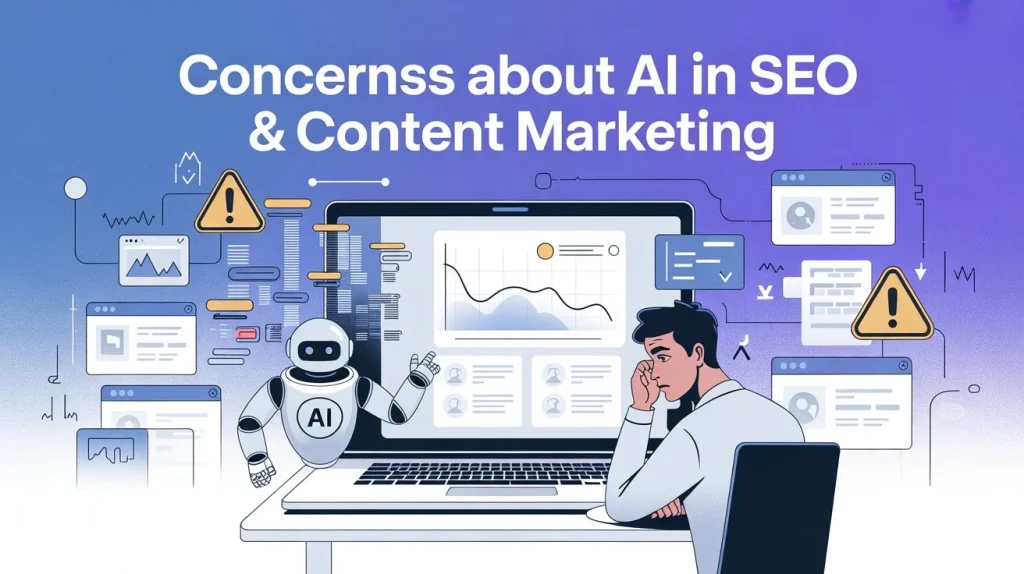
This shift has created growing concerns about AI in SEO and content marketing — especially around rankings, authenticity, EEAT, misinformation, and long-term visibility.
The biggest issue is not AI itself.
The real problem is relying on AI without strategy, expertise, or human oversight.
In this guide, you’ll learn:
- The biggest risks of AI-generated content
- How AI is affecting SEO in 2026
- Why many AI articles fail to rank
- How Google evaluates AI content
- The impact of AI Overviews on organic traffic
- Smart ways to use AI safely without hurting rankings
Table of Contents
What Are the Main Concerns About AI in SEO?
The biggest concerns about AI in SEO include:
- Declining content quality
- Lack of originality
- Weak EEAT signals
- Search intent mismatch
- AI-generated misinformation
- Keyword stuffing
- Over-reliance on automation
- Generic brand voice
- Content saturation
- Loss of organic traffic from AI Overviews
Google’s ranking systems now prioritize:
- Helpful content
- User satisfaction
- Experience-based insights
- Expertise and trust
- High-value information
This means websites publishing low-quality AI content are increasingly struggling to rank.
Impact of AI on SEO and Content Marketing
AI has transformed content marketing at every level.
Businesses now use AI for:
- Content creation
- SEO optimization
- Topic clustering
- Keyword research
- Workflow automation
- SERP analysis
This evolution is also reshaping broader strategies in AI in Digital Marketing, where automation and personalization are becoming central to modern marketing campaigns.
While AI improves efficiency, it has also dramatically increased competition. Since almost anyone can now generate content quickly, the internet is becoming saturated with similar articles targeting the same keywords.
As a result, ranking in search results now requires more than just publishing content.
It requires publishing better content.
Top Concerns About AI in SEO and Content Marketing
1. Decline in Content Quality
One of the biggest concerns about AI-generated content is declining quality.
AI tools often create:
- Repetitive explanations
- Generic advice
- Surface-level insights
- Weak storytelling
- Thin informational content
At first glance, AI-generated articles may look polished. But upon closer reading, users often realize the content lacks depth and originality.
Common Issues:
- No real examples
- Weak expertise
- Generic structure
- Repeated information
- Limited practical value
Google’s Helpful Content System specifically targets content that exists primarily to rank rather than to help users.
Why It Matters
Low-quality content often leads to:
- Higher bounce rates
- Reduced trust
- Lower engagement
- Weak SEO performance
In 2026, quality matters more than content volume.
2. The Authenticity Problem With Generative AI
Authenticity is becoming one of the strongest ranking factors in modern SEO.
Users increasingly prefer content that includes:
- Real experience
- Original opinions
- Practical examples
- Expert insights
AI struggles with this because it cannot naturally provide firsthand experience.
Why AI Struggles Here:
- No real-world testing
- No personal expertise
- No emotional understanding
- No genuine experience
This creates a major gap between AI-generated content and truly authoritative content.
For example, an SEO strategist who has worked on ranking recovery campaigns can explain:
- What worked
- What failed
- Real traffic impacts
- Practical lessons learned
AI cannot naturally replicate those insights.
3. Maintaining E-E-A-T Standards
Google increasingly prioritizes EEAT:
- Experience
- Expertise
- Authoritativeness
- Trustworthiness
AI alone cannot build strong EEAT signals.
That’s why websites relying entirely on automation often struggle to establish credibility.
Ways to Strengthen EEAT:
- Add author bios
- Include expert commentary
- Share case studies
- Use original examples
- Cite trusted sources
- Add personal insights
Content that combines AI efficiency with human expertise performs significantly better in search results.
4. Content Originality and Duplicate Content Concerns
AI models generate content based on existing online information.
As a result:
- Many articles sound similar
- Topics become repetitive
- Originality decreases
- Competitive differentiation becomes difficult
Result:
- Generic content across websites
- Lower uniqueness
- Weak topical authority
- Reduced ranking potential
Google increasingly rewards original insights and unique perspectives.
In competitive industries, originality is now a major SEO advantage.
5. Search Intent Mismatch
Search intent plays a critical role in rankings.
AI tools often generate broad responses without fully understanding what users actually want.
AI Limitations:
- Generic answers
- Weak contextual understanding
- Incomplete solutions
- Poor audience targeting
For example, someone searching:
“concerns about AI in SEO”
expects:
- Ranking risks
- Google update insights
- Real SEO concerns
- Practical solutions
—not generic definitions about artificial intelligence.
Content that directly solves user problems consistently performs better.
6. Google’s Detection and Penalty Risks
Google has repeatedly stated that AI-generated content is not automatically penalized.
However, Google does target:
- Spam automation
- Thin content
- Manipulative SEO tactics
- Low-value mass publishing
Important Reality:
Google evaluates content quality — not whether AI created it.
This means:
- Helpful AI-assisted content can rank well
- Low-quality human-written content can fail
The issue is not AI.
The issue is low-value content.
7. Losing Organic Traffic to AI Overviews
One of the biggest SEO concerns in 2026 is the rise of AI Overviews.
Google increasingly answers informational queries directly in search results using AI-generated summaries.
This creates:
- Lower click-through rates
- More zero-click searches
- Reduced organic traffic
- Less visibility for informational pages
Even websites ranking in top positions may lose clicks if Google answers the query directly.
This is why businesses are increasingly focusing on how to Show Up in AI Overviews SEO to maintain visibility in AI-driven search results.
To adapt, brands must optimize for:
- Direct answers
- Structured formatting
- Entity-based SEO
- High-authority content
8. Risk of Misinformation
AI tools can sometimes generate inaccurate or outdated information.
Risks Include:
- Incorrect facts
- Fake references
- Outdated statistics
- Misleading recommendations
This becomes especially dangerous in:
- Health
- Finance
- Legal
- SEO strategy industries
Publishing inaccurate information damages:
- User trust
- Brand authority
- Credibility
- Search performance
Human review and fact-checking remain essential.
9. Over-Reliance on Automation
Many businesses now depend too heavily on AI for:
- Writing
- Optimization
- Keyword research
- Workflow scaling
While AI improves efficiency, over-dependence creates long-term strategic problems.
Long-Term Effects:
- Reduced creativity
- Weak brand positioning
- Generic marketing
- Poor differentiation
The most successful SEO teams use AI as a support system — not a replacement for strategic thinking.
This balance is becoming increasingly important as businesses scale workflows through How AI SEO Tools Help Scale Agile SEO.
10. The Strategic Risk: Confusing Output With Strategy
One of the biggest misconceptions in AI SEO is:
“Publishing more content automatically improves rankings.”
It doesn’t.
SEO success still depends on:
- User experience
- Search intent
- Topical authority
- Content usefulness
- Trust signals
Publishing hundreds of AI-generated pages without strategic planning usually leads to poor long-term performance.
AI can accelerate execution.
It cannot replace an SEO strategy.
11. Keyword Stuffing and Unnatural Language
AI-generated content often becomes over-optimized.
Many AI tools excessively repeat keywords in an attempt to improve rankings.
Common Problems:
- Robotic phrasing
- Forced keywords
- Awkward readability
- Unnatural structure
Modern search engines prioritize natural language and readability over keyword density.
Over-optimization now hurts rankings more than it helps.
12. Weak Brand Voice and Trust Issues
AI-generated content often sounds generic and emotionally flat.
This weakens:
- Brand identity
- Audience trust
- Engagement
- User connection
Strong brands stand out because of:
- Unique tone
- Clear messaging
- Authentic communication
- Original insights
Human editing is essential for maintaining a strong brand voice.
13. Content Saturation Is Flooding the Web
AI has dramatically increased content production across nearly every industry.
As a result:
- Competition is higher
- Ranking is harder
- Similar content is everywhere
The internet is becoming flooded with:
- Generic blogs
- Rewritten information
- Low-value summaries
- Repetitive SEO articles
This growing saturation is also influencing broader trends in Digital Marketing in 2026, where differentiation and authority are becoming more important than publishing frequency.
AI Doesn’t Break SEO. It Exposes Bad SEO.
AI is not destroying SEO.
It is exposing weak SEO strategies.
Websites that relied on:
- Thin content
- Keyword stuffing
- Low-value publishing
- Generic blog production
We are struggling because AI has made mediocre content easier to create at scale.
Meanwhile, websites focused on:
- Expertise
- Originality
- User experience
- Helpful information
continue to perform well.
The fundamentals of SEO have not changed.
Helpful content still wins.
The Reality of AI Search and LLMs
Search behavior is rapidly changing because of:
- AI search engines
- LLM-powered assistants
- Conversational search
- AI-generated answers
Users increasingly receive direct answers instead of clicking multiple websites.
This means SEO strategies must evolve.
Modern SEO now requires:
- Structured information
- Entity optimization
- Clear formatting
- Concise answers
- Trustworthy content
Brands that adapt early to AI-driven search ecosystems will maintain stronger long-term visibility.
How to Use AI Safely in SEO and Content Marketing
AI is not harmful when used correctly.
The goal is not to avoid AI.
The goal is to combine AI efficiency with human expertise.
Use AI as a Support Tool
AI works best for:
- Topic research
- Content outlines
- Optimization suggestions
- Workflow efficiency
- SERP analysis
Avoid publishing raw AI-generated drafts without editing.
Add Human Experience
Improve content quality by including:
- Real examples
- Personal insights
- Case studies
- Industry observations
- Expert opinions
This strengthens EEAT and improves trust.
Optimize for Search Intent
Always focus on:
- User problems
- Clear solutions
- Helpful experiences
- Audience expectations
Intent-focused SEO consistently outperforms keyword-focused content.
Edit and Improve Content Thoroughly
Human editing remains critical.
Review content for:
- Accuracy
- Clarity
- Readability
- Tone
- Originality
- Value
Strong editing dramatically improves SEO performance.
Use Internal Linking Naturally
Internal linking helps:
- Improve crawlability
- Build topical authority
- Increase engagement
- Strengthen semantic relevance
Relevant topics include:
- How to Show Up in AI Overviews SEO
- How AI SEO Tools Help Scale Agile SEO
Natural internal linking improves both user experience and SEO structure.
The Real Question Brands Should Be Asking
Instead of asking:
“Can AI-generated content rank?”
Brands should ask:
- Does this content genuinely help users?
- Is it trustworthy?
- Is it better than competing pages?
- Does it solve real problems?
- Would users actually engage with it?
That is what modern SEO is truly about.
Final Thoughts
AI is transforming SEO and content marketing faster than ever before.
But the biggest concern is not AI itself.
The real risk is abandoning the fundamentals of good SEO:
- Helpfulness
- Expertise
- Originality
- User experience
- Trust
Websites relying entirely on automation will increasingly struggle to rank.
Meanwhile, brands are combining:
- AI efficiency
- Human creativity
- Strategic SEO
- Authentic expertise
- High-quality content
will continue to grow in search visibility.
In 2026, successful SEO is no longer about publishing the most content.
It’s about publishing the most useful content.
FAQs
Is AI-generated content bad for SEO?
No. AI-generated content is not bad for SEO if it is accurate, helpful, original, and user-focused.
Why does AI content often fail to rank?
Most AI-generated pages fail because they lack:
Depth
Originality
EEAT signals
Intent optimization
Trustworthiness
Google prioritizes genuinely helpful content.
Does Google penalize AI-generated content?
Google does not penalize content simply because it is AI-generated. However, spammy or low-quality content can lose rankings regardless of how it was created.
Can AI replace human content writers?
No. AI improves efficiency, but human expertise, creativity, and strategic thinking remain essential for high-quality SEO content.
How can I make AI content rank better?
To improve rankings:
Add original insights
Include real examples
Optimize for search intent
Edit thoroughly
Strengthen EEAT signals
Improve readability and structure